
Most companies already use AI to create content. The problem is that AI doesn't know their brand. The fix is simpler than you'd think: one file.
Ask any AI tool to make a presentation, a post or an ad today, and you'll get something back in seconds. It's impressive – until you look closer. The wrong colours. A font that isn't yours. A tone of voice that could belong to anyone. The result is generic, and you spend as long fixing it as you saved by generating it.
There's nothing wrong with the AI. It's just missing the one thing it needs: an understanding of your brand.
Design.md: your brand, written for machines
A design.md is a simple text file that gathers your visual identity in one place: colours, fonts, logo usage, image style and tone of voice. Not a PDF manual nobody opens, but structured text an AI tool can read and follow – every time.
Think of it as your brand's DNA, translated into a language machines understand. With the file in place, the AI stops guessing. It knows the headings should be in your font, that your primary colour is exactly that colour, and that you write directly and warmly – not stiff and corporate.
What it gives you
A design.md is small in scope, but makes a real difference in practice:
- On-brand from the first try. Ask for a campaign poster or a LinkedIn post, and it looks like you straight away – not after five rounds of corrections.
- Everyone pulls in the same direction. The marketing manager, the intern and the agency you hired all work from the same source. No more «which blue was it we used again?»
- Speed without losing quality. You keep the speed AI gives you, without sacrificing your visual identity to get it.
- A living document. As the brand evolves, you update the file – and everything built on it follows.
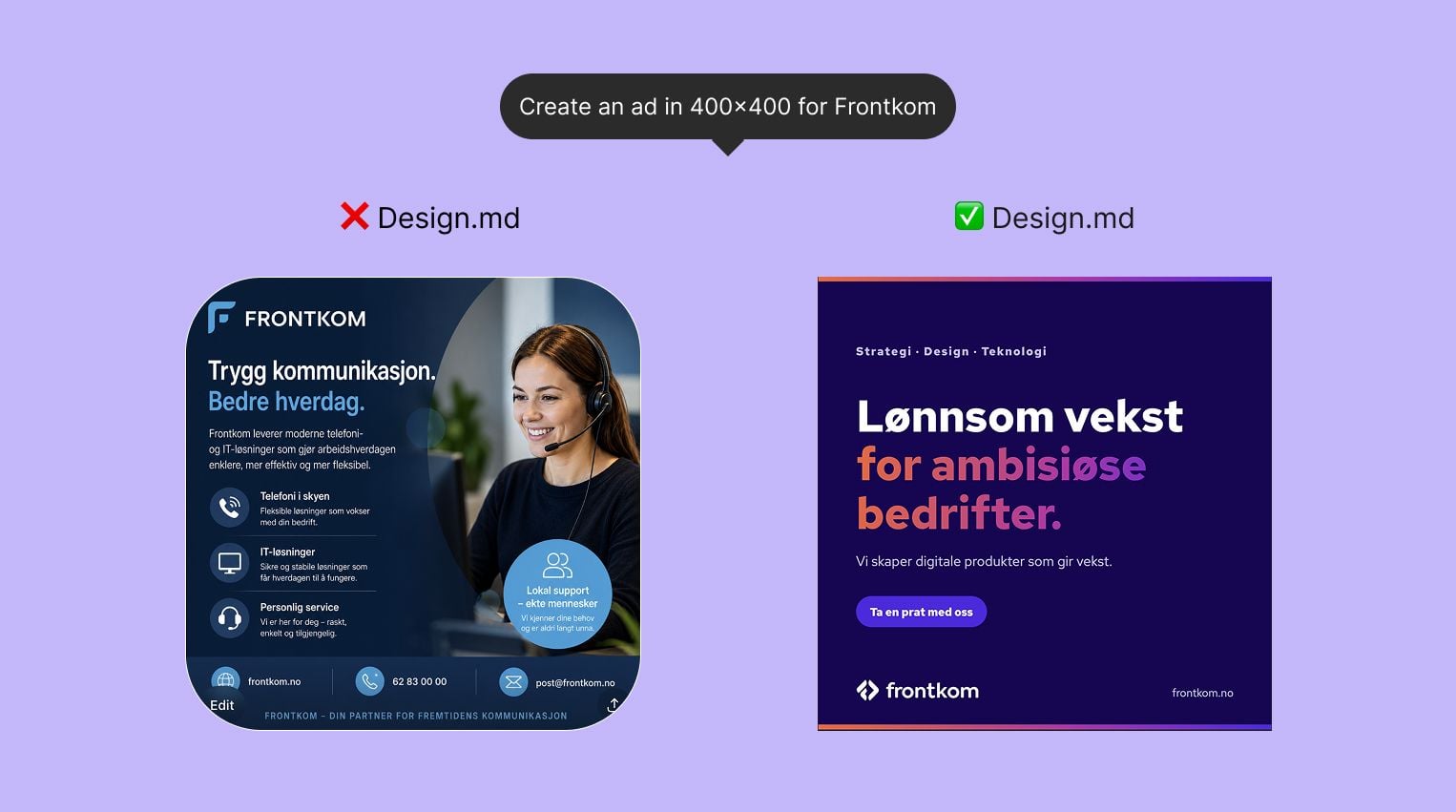
What it looks like day to day
A marketing coordinator needs to make ten versions of an ad for different channels. Instead of adjusting colours and fonts manually in every single one, she points the AI tool at the design.md file. Ten on-brand drafts, ready for polishing.
A CEO needs a pitch ready by tomorrow morning. He types in his key points, asks for a presentation based on the brand – and gets something that looks professional and recognisable, without waking the designer in the middle of the night.
It's not magic. It's simply what happens when the tool finally knows who it's working for.
Why this matters now
AI has gone from something you test to something you work in. Companies are already creating content with it – the question isn't whether, but how well. Those who give the AI a clear brand framework will stand out from the sea of generic content. Those who don't will drown in it.
A design.md is the cheapest, fastest step a company can take to turn AI into a real brand asset instead of a source of more work.
New: share the file with your whole organisation in Claude
Since we wrote this in June, Claude has gained a feature that makes a design.md much easier to keep up to date. On Team and Enterprise plans, you can package your brand file as a skill and publish it to your entire organisation straight from Claude.
That solves a problem most teams run into sooner or later. The file is only as good as the version people use, and if it lives in an email, a shared folder or someone's downloads, it doesn't take long before someone is working from a copy that's six months old.
With a published skill there is only one source. When you put out a new version, everyone who has the skill installed gets the update automatically. Change your primary colour or get a new logo, and the change is in place across the organisation the next time someone asks Claude for a presentation.
Owners of your Claude organisation decide how the skill is offered: available to install, installed by default or required. You can also require every new version to be approved before it rolls out, so whoever is responsible for the brand stays in control of what goes out.
A skill can also hold more than text. Logo files and fonts can sit in the same package, so Claude uses the real files instead of drawing the logo from memory. The skill works in chat on the web, in Claude Desktop, in Cowork and in Claude Code, so marketing and developers work from the same brand.
We do the same with Frontkom's own identity. Logos, the Red Hat fonts and the rules for using them sit together in one skill, which we use for presentations, ads and prototypes.
We'll make the file for you
At Frontkom we know brands, and we know the tools. Distilling your visual identity into a precise, AI-friendly design.md is something we do quickly – and it becomes a foundation you use every single day, not a manual that ends up in a drawer.
If you use Claude, we can also package the file as a skill and help you publish it across your organisation.
Want to see what your own design.md would look like? Get in touch.